

Is Colombia actually accessible, or does that word mean something different depending on who is asking?
We got a real answer to that question this year, not from a brochure but from six specialists who each work with a different kind of disability, on the ground with us for a week: a wheelchair-travel expert, a blind traveler who runs his own tour company, an advisor who works with neurodivergent travelers, someone focused on accessibility tied to dietary needs, and two more who have spent years testing what accessible actually means in practice. ProColombia backed the trip. We ran the logistics. What we got back was not a checklist. It was a much better question, and this guide is built around it.

Stop asking is it accessible. Start asking accessible for whom
Here is the instinct we had to unlearn. Calling a hotel or an excursion accessible feels like enough when you are the one selling it. It is not, and we would go further: it is the wrong question entirely.
Even two wheelchair users can need completely different things. One traveler transfers independently, another needs help. One uses a manual chair, another electric. Terrain that is nothing to one person can be impossible for the next. The same is true across visual disabilities, neurodivergence, dietary needs, and everything else we tend to flatten into one word.
So instead of this is accessible or this is not, we try to answer: this is what you will encounter, is it right for you? Steps and how many. Room in the bathroom for a specific chair. Whether the shower has a seat. Whether a transfer is involved. Whether the ground is stone, sand, cobblestone, or pavement. Whether the environment is loud or crowded. Whether the information reaches you visually, audibly, or by touch. The better the description, the better you decide for yourself, and that is worth more to us than promising a fully accessible trip that falls apart the moment someone actually lives it.
We learned that lesson the direct way. On a beach we had operated before and genuinely believed was accessible, a specialist with more expertise than we had pointed out what we had missed: an accessible bathroom does not solve much if reaching it means crossing loose sand while being pushed the whole way. Infrastructure can technically do its job while the experience around it still has real barriers. If we had to pick one lesson from that whole week, it is that one.

The Coffee Region: what a wheelchair or a blindfold actually changes
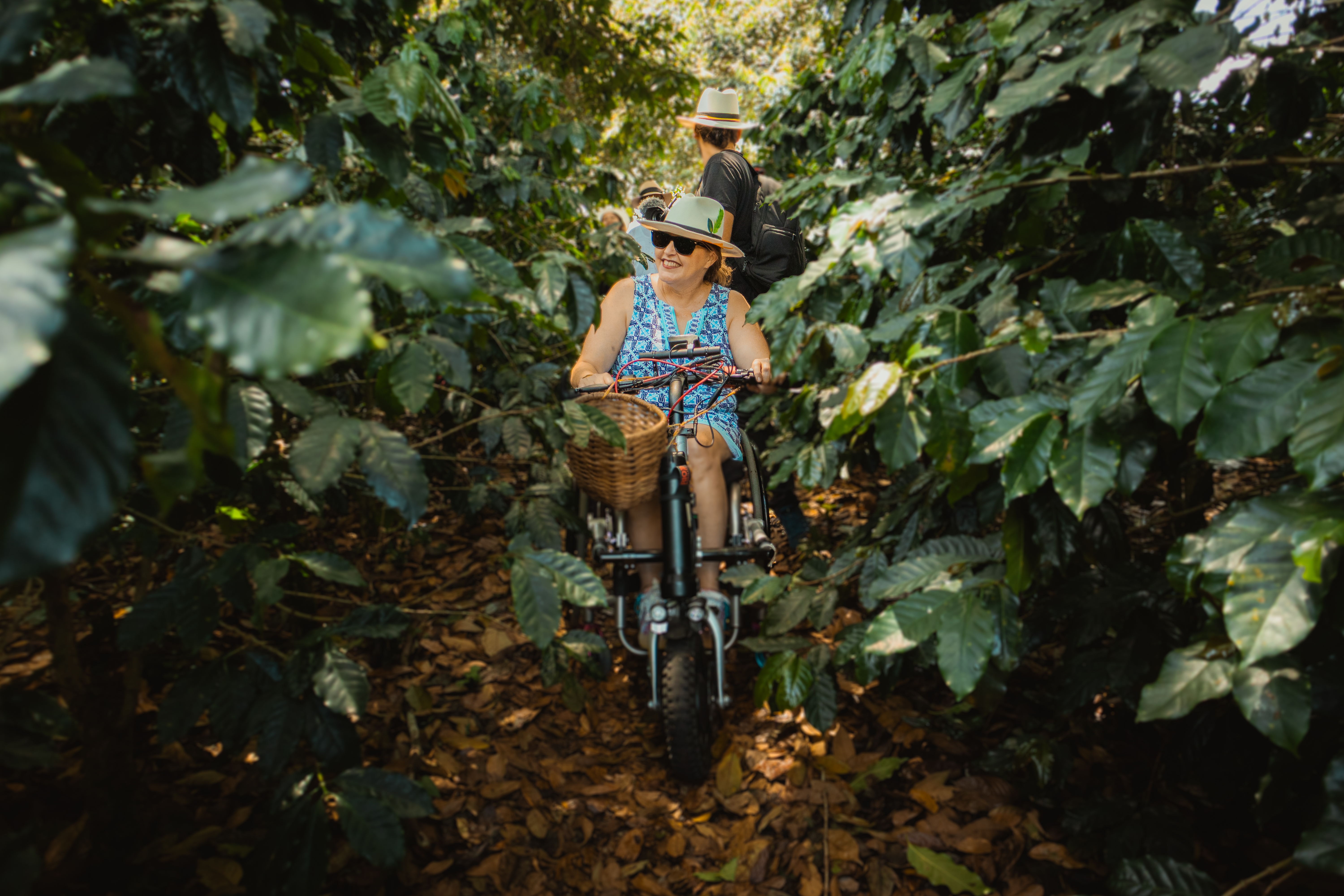
The Coffee Region’s farms were not built with wheelchairs in mind, and we are not going to pretend every one of them works. But a growing number have adapted their paths well enough that a wheelchair user can roll through the rows, not just watch from the entrance, and take part in the full walk from picking to cup.
Two experiences hold up especially well because they were never about walking in the first place:
- Blind coffee tastings. Cupping is a smell-and-taste discipline before it is anything else, so a blindfold changes almost nothing about how the experience actually works. We have run these with blind travelers and watched them pick up notes a sighted taster missed entirely.
- Sensory chocolate-making with cacao. Touch and smell carry the whole workshop, from bean to bar, so it holds up the same way for blind, low-vision, and sighted travelers alike.
Recuca, one of the farms we work with, runs an adapted handcycle route through the coffee rows, which is what let us put a wheelchair user through the full plantation walk rather than a shortened version of it.

Medellín: a motor that clips onto your own chair
Medellín’s streets were not designed for wheelchairs either, and the slopes are real. What changes the equation is a detachable motor, similar to a Firefly, that clips directly onto a manual wheelchair and turns it into something closer to a trike.
The point is not the gadget. It is that you keep your own chair the entire time. You glide through the city alongside everyone else in your group, and when you reach a museum, a restaurant, or one of the plazas, you unclip the motor and go in on your own terms rather than being transferred into something else. No one in the group has to slow down or split off.

Bogotá: the market and the garden that work for two different reasons
Bogotá is where the tension is most visible. We walked the group through La Candelaria, the colonial center, because you cannot understand this city’s history without it, and it is exactly what you would expect from a 500-year-old neighborhood: narrow cobblestone streets, uneven surfaces, buildings that predate any accessibility code. We are not going to describe that as easy. It is not.
Two places nearby work for reasons that have nothing to do with each other, and we think both deserve more attention than they get.
Paloquemao Market is Bogotá’s main fruit and flower market, and it is built for something a manicured attraction never quite manages: it is genuinely multisensory. The smell of fruit most travelers have never encountered, the sound of vendors calling out prices, textures you are invited to touch before you buy. For a blind or low-vision traveler, that is not a workaround experience, it is arguably the best version of a Bogotá market visit available to anyone. The floors are mostly flat concrete, which helps wheelchair users, though the aisles get narrow and crowded at peak hours and the sections near the juice stalls and flowers can get wet. Going early on a weekday morning and going with a guide who knows the layout solves most of that.
The Jardín Botánico de Bogotá solves a different problem. Its main paths are wide and paved, and the garden keeps wheelchairs on site for visitors who need one, which means it is one of the more straightforwardly navigable green spaces in the city. For low-vision and blind travelers, it works for the opposite reason Paloquemao does: it is quiet, it is organized by scent and texture rather than by sight, and a guided walk through the collections turns into a genuine sensory tour rather than a description of things you are told are pretty.
Then there is Tejo. It is one of the most Colombian things you can do, and we did not want an accessible itinerary that quietly dropped it because it seemed complicated. We adapted the lanes instead of cutting the activity, and one of our blind travelers played it, and played it well, while the lanes next to him looked over with a mix of surprise and curiosity. Adapting an experience does not mean losing what makes it that experience.

Getting there and getting around
On the ground, this comes down to vehicles. A wheelchair-accessible van with a lift or ramp, checked in advance rather than assumed, is what actually makes a multi-city itinerary work, and it is the piece that is easiest to get wrong if you are planning this yourself from another country.
In the air, every major airline flying into Colombia, Avianca, LATAM, Iberia among them, provides wheelchair assistance through the airport and onto the plane, and Colombian law requires it. Give 24 to 48 hours notice when booking. One detail worth confirming directly with the carrier at booking time: some domestic airlines offer in-cabin storage for rigid-frame wheelchairs rather than checking them into the hold, which matters if a damaged chair is one of your biggest travel fears. Policies change, so we verify this with the airline every time rather than assume it still holds.

What we ask before we plan anything
We stopped opening with what accessible product do you need a while ago, because it is the wrong first question. These are the ones that actually shape a good itinerary:
- What do you want to experience, specifically, not just in general?
- What do you need to feel comfortable and safe?
- What can you do independently, and where do you need assistance?
- Which barriers are you willing to face, and which ones are a hard limit?
- What matters most to you on this trip?
- What are you comparing Colombia to, based on other places you have traveled?
That last one matters more than it looks. Someone living with a disability in Madrid or London may walk in with expectations shaped by infrastructure Colombia does not have yet. That does not mean turning Colombia into somewhere it is not. It means being honest about the gap and building the trip around your actual limits, not a generic one.

Frequently asked questions
Is Colombia accessible for wheelchair users?
Unevenly, and honestly. The Coffee Region, Medellín, and parts of Bogotá offer real accessible tours, attractions, and hotels, and infrastructure improves every year, but colonial centers like La Candelaria remain genuinely difficult. What matters is matching the destination to what you can navigate, not assuming the whole country works the same way.
Is Bogotá’s Jardín Botánico wheelchair accessible?
Its main paths are wide and paved, and the garden keeps wheelchairs on site for visitors who need one. It is one of the more straightforward green spaces in the city to navigate.
Is Paloquemao Market accessible for blind or low-vision travelers?
Yes, and arguably more so than most conventional attractions, because it is built around smell, sound, and touch rather than sight. Floors are mostly flat, though aisles get crowded and can be wet near the juice and flower sections, so an early visit with a guide who knows the layout works best.
Which airlines accommodate wheelchair users in Colombia?
All major carriers flying into Colombia provide wheelchair assistance through the airport and onto the plane, and it is a legal obligation, not a courtesy. Give 24 to 48 hours notice when booking. Some domestic airlines offer in-cabin storage for rigid-frame wheelchairs; confirm this directly with the carrier, since policies change.
Are there accessible tours in the Coffee Region?
Yes. Several farms, including Recuca, have adapted paths and handcycle routes for wheelchair users, and blind coffee tastings and sensory chocolate-making work well for blind and low-vision travelers specifically because they were never built around sight in the first place.
What does Impulse actually do differently for accessible trips?
We describe what you will encounter in enough detail for you to decide if it is right for you, instead of labeling a trip accessible and hoping it holds up. We build the itinerary around your specific needs rather than a generic accessible package, and we have been wrong before and corrected it in the open, which is part of why we trust our own answers now.
So, is Colombia accessible?
Partway through that week, one of the specialists asked us directly: why are you doing this, it is really hard. She was not wrong. Some days you solve one barrier and find two more waiting behind it.
But the answer is not Colombia is not accessible, and it is not a confident yes either. It is closer to what we said at the start: tell us what you need, and let us see what we can do. Colombia was not built around today’s accessibility standards, and it is genuinely learning, faster in some places than others. What we can promise is not a barrier-free country. It is a description you can trust, a team that has been wrong before and said so, and a trip built around your limits instead of a label.
Ready to plan an accessible trip to Colombia? Contact us, tell us what you need, and let’s see what we can do.


