

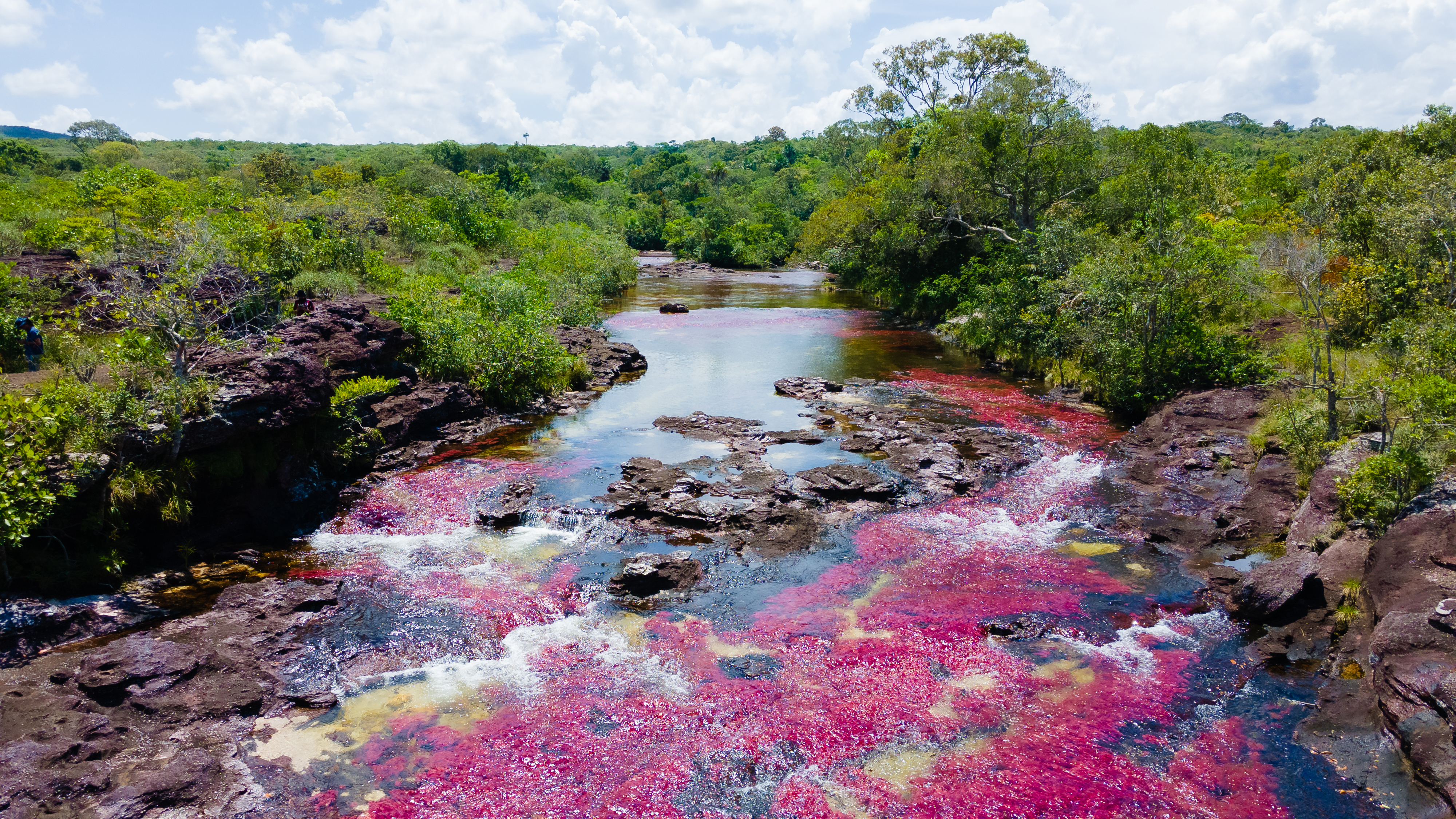
Is there really a river that changes color on its own, and if there is, why isn’t it the first thing anyone tells you to see in Colombia?
People ask me all the time what to actually do here, beyond Cartagena and the coffee farms everyone already has on their list. There’s one answer I give that almost always gets the same reaction: a short pause, then “wait, that’s real?” I’m talking about Caño Cristales, the river of five colors.
Someone once described it to me as “the river on acids.” I laugh every time I tell that story, but honestly, I don’t entirely disagree.
Here’s what it actually is. Caño Cristales is a stretch of river deep in the Sierra de La Macarena where, for a few months each year, an aquatic plant called Macarenia clavigera blooms across the riverbed and turns the water red, gold, and green. Five colors, not a filter, not a trick of the light. A short flight from Bogotá. And still, somehow, one of the most underrated natural wonders we have in this country.

More than a river
Part of what gets lost in a photo, and I think this is the part that matters most, is that the river isn’t the only reason to go. Caño Cristales sits right at the point where three of Colombia’s major ecosystems meet: the Andes coming down from the west, the Amazon reaching up from the south, and the Llanos, the Orinoquía, opening out toward the horizon. That convergence alone would be worth the trip for me, even without the color.
And then there’s the culture around it, which I think gets even less credit. This is llanero country. Cattle land, harp and cuatro music, food built around whatever the plains actually produce that week. Late in the day, that’s usually where the trip lands for people: joropo played live on the riverbank. Nobody’s staging it for visitors. It’s just what people there play, and that’s exactly why it lands the way it does.
Ten years ago, this wasn’t even a question
Here’s the part that actually explains why so few people know about it. Ten years ago, visiting Caño Cristales wasn’t something you planned. It was something you couldn’t do. The region sat inside decades of armed conflict, and access was effectively closed. The peace agreement changed that, and slowly, the town of La Macarena went from unreachable to open.
I say “slowly” on purpose. Opening a region doesn’t happen the day a document gets signed. It takes years of unglamorous work that nobody outside of it ever sees: guides getting certified, National Parks and Cormacarena setting up the permit system that still governs every visit today, the first flights, the first travelers willing to take the risk before it was a known thing. What I find genuinely moving about La Macarena today isn’t the color of the river. It’s a community that built a tourism economy out of a place most of the world had written off, and that did it on its own terms.

What the first day actually looks like
You land in La Macarena, and before anything else happens, there’s a briefing on how the Sierra de La Macarena National Park actually works: what’s protected, why, and what that means for the three or four days you’re about to spend inside it. I think this part matters more than people expect. It’s not a formality. It’s the moment you understand you’re a guest in something the community fought to keep, not a tourist site that was built for you.
From there, you get into a wooden boat and head down the Guayabero River. Twenty minutes or so, then a hike that climbs to El Mirador, a lookout with the river winding through the jungle below and the savannah opening up on the other side. Monkeys and birds along the trail, most of the time.
From El Mirador, the walk continues to Caño Cristalitos, which is the part almost nobody mentions by name. It’s a smaller stream than the main river, and it’s your first real contact with Macarenia clavigera, the plant responsible for all of this. Same red and pink tones, same clear water, in miniature. Most itineraries save the big reveal for a later day, but Cristalitos is where the river actually introduces itself, and I’d argue it deserves more attention than the footnote it usually gets.
By the time you reach the lodge that evening, tucked into the forest, you’ll likely see squirrel monkeys moving through the trees around the cabins. That’s not a detail someone added for atmosphere. It’s what happens when a property is built to sit inside the forest instead of clearing it, which is exactly the point of where we choose to put people for the night.

Where you actually stay
This is the part I mentioned earlier that most people haven’t caught up to. One of the lodges we work with in La Macarena was built around the forest instead of on top of it. They kept the trees standing, tree by tree, rather than clearing the lot first and landscaping after, and it runs on renewable energy with construction that was designed to leave as little mark as possible.
What I like about it is that the arrangement goes both ways. The trees shade the cabins from a sun that gets brutal by midday and break the wind that comes off the plains, and in exchange, the forest keeps doing what it does around the property: birds, squirrel monkeys, the occasional something you didn’t expect to see from a hammock. It’s a small, specific example of the same idea driving the whole region’s tourism now, that protecting what’s here is what makes it worth visiting at all.
What we actually do
Anyone can point you at a flight and a hotel room. What I think we actually bring is knowing, in advance, which trail is running that week, which of the handful of properties in town is worth the extra effort to secure, and how to build the days so the boat, the hike, Cristalitos, and the main river feel like one trip instead of a checklist nobody planned well. We take care of the Cormacarena permit and the trail assignment before you ever have to think about it, because that part genuinely can’t be improvised once you land.
Frequently asked questions
When is the best time to visit Caño Cristales?
The color season runs roughly June through November, with July through October generally the strongest. Outside that window, the river runs too high or too low for the plant to show its color.
How many days do you need?
Three days is the practical minimum once you account for the flight in, a full day at the river, and the flight out. Four or five gives you room for a second trail and lets the itinerary flex if the weather shifts a day’s plan.
What’s the difference between Caño Cristales and Caño Cristalitos?
Caño Cristalitos is a smaller stream near the main river, and it’s usually the first place you see Macarenia clavigera up close, often on day one before you reach the main Caño Cristales trail. Same plant, same colors, smaller scale.
How do you get to Caño Cristales?
By short flight to La Macarena, most commonly from Bogotá. There’s no practical road route for a standard visit.
Is a guide required?
Yes. Access is only permitted with a certified local guide, and trails are assigned in advance through Cormacarena and National Parks, not chosen on the day.
What’s not allowed inside the park?
Sunscreen, insect repellent, and single use plastic are all prohibited, because their chemicals damage the aquatic plant responsible for the river’s color. Long sleeves and a hat handle the sun instead.
Is Caño Cristales worth the trip?
For most travelers, yes, especially if the ecosystem and the culture around it matter as much to them as the river itself. It rewards people who go in wanting the plains, the music, and the food alongside the color, not just the photo.
Was Caño Cristales always open to visitors?
No. The region was closed for decades during Colombia’s armed conflict and reopened gradually after the 2016 peace agreement, first with basic infrastructure and, more recently, with a real jump in the quality of local lodging.

So why isn’t Caño Cristales the first thing anyone tells you to see in Colombia?
Because for most of the last few decades, it wasn’t something anyone could actually see. Being extraordinary was never the problem here. Being reachable was. What changed isn’t the river. It’s everything around it: the peace, the permits, the flights, and finally, somewhere decent to sleep at the end of the day, built by people who understood what they were sitting on. It’s not a secret anymore, and it never should have been one in the first place. It’s just still new enough that most people haven’t caught up.
Want to see it for yourself? Talk to us about a trip to Caño Cristales, and I’ll make sure the flight, the permit, and the part of the trip nobody tells you about until you’re already there are all handled before you land.


