

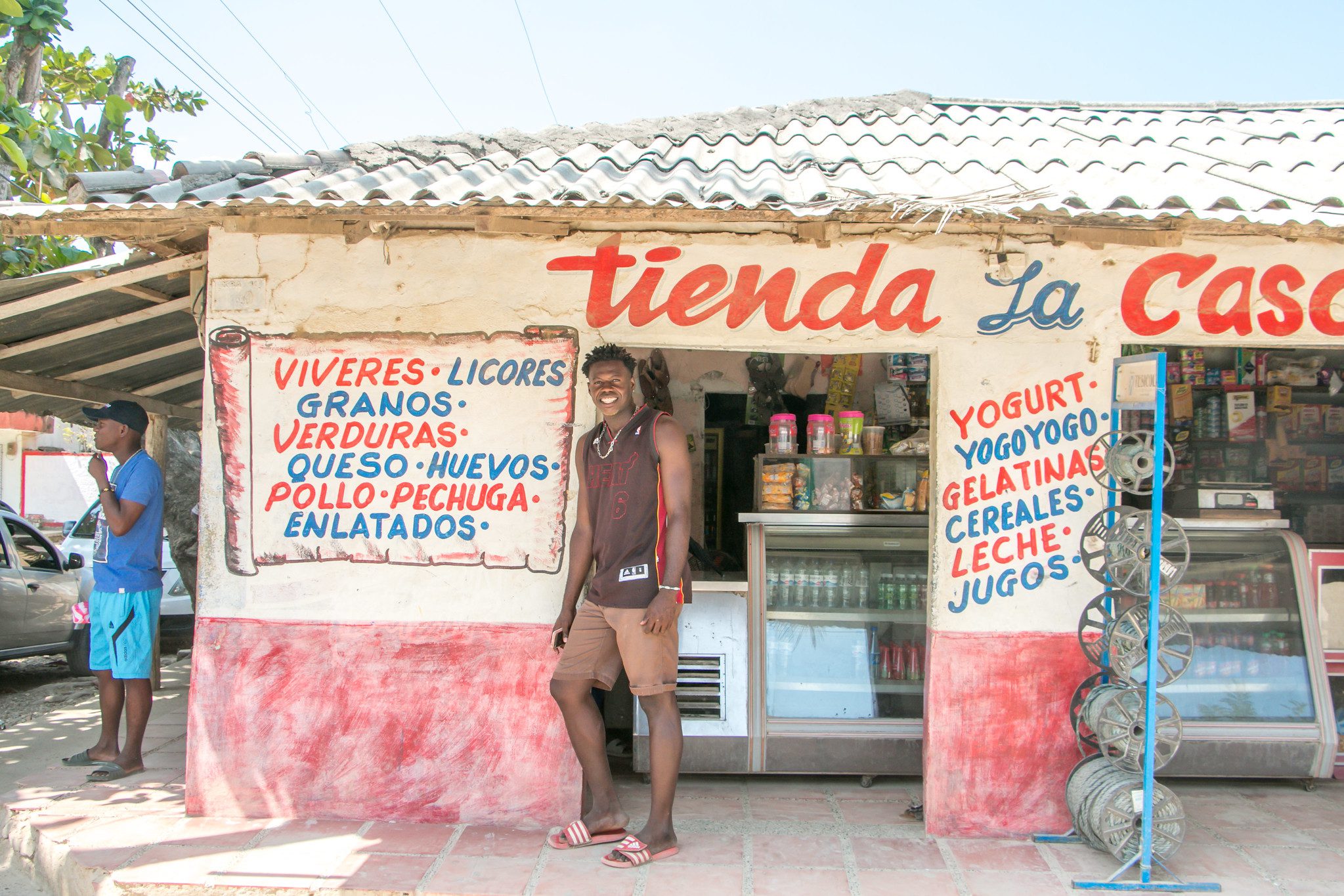
San Basilio de Palenque is the first free town in the Americas. It was founded in the early 17th century by Africans who escaped slavery in Cartagena, and it still stands 50 km southeast of the city, in the foothills of the Montes de María. It can be visited as a day trip. UNESCO proclaimed its cultural space a Masterpiece of the Oral and Intangible Heritage of Humanity in 2005 and inscribed it on the Representative List in 2008.
If you have been to Cartagena, you have almost certainly seen the palenqueras: women in bright dresses selling fruit and sweets in the old town. They come from here. Behind that image is a story of resistance that rarely gets told in full, and a town where people still speak a language that exists nowhere else on earth.

Plaza de San Basilio de Palenque
Where is San Basilio de Palenque located?
You will find San Basilio de Palenque, one of the most important historical villages of Colombia, 50 km southeast of Cartagena, in the foothills of the mountain range Montes de María. It belongs to the municipality of Mahates, in the department of Bolívar. It is the first town in the Americas that freed itself from slavery, founded by escaped African captives. In the early 1600s they opposed oppression and due to that, the town of San Basilio represents the African emancipation from servitude in America until today.
Location: San Basilio de Palenque
People living there are known for their rich and unique culture, influenced heavily by their African heritage. UNESCO proclaimed the Cultural Space of Palenque de San Basilio a Masterpiece of the Oral and Intangible Heritage of Humanity in 2005, and inscribed it on the Representative List of the Intangible Cultural Heritage of Humanity in 2008.
What is the history of San Basilio de Palenque?
During the seventeenth century, Cartagena was one of the main hubs for the slave trade in Colombia. Some slaves escaped oppression and founded walled communities – so-called “Palenques” – in the mountains and jungles surrounding Cartagena, which offered shelter to them.
Most of the other secret fort villages were eventually found and destroyed by the Spanish. San Basilio is the only Palenque town that survived and that still exists today.
Due to the isolation of the refuge, the inhabitants could preserve their unique cultural heritage for a long time. However, outside of San Basilio, Palenque people were discriminated against many times and became victims of stereotyping which often led them to deny their traditional customs.
With the recognition of the UNESCO, a new pride in their culture emerged and now values, traditions, and language are embraced by the community.
Who was Benkos Biohó?
The founder father of San Basilio de Palenque, Domingo Benkos Biohó, originally from the Bijago islands of Guinea-Bissau in West Africa was born in the Biohó kingdom, located in the Guinea-Bissau region.
He was likely of noble birth or held a position of leadership within his community, as he demonstrated exceptional leadership skills later in life.
In the late 16th century, during the height of the transatlantic slave trade, Benkos Biohó was captured by Portuguese slave traders. He was forcibly taken from his homeland and sold into slavery.
His capture and enslavement were part of the widespread European practice of raiding African villages and capturing individuals to supply the demand for labor in the Americas.
There is a mystery around the history of his escape from Cartagena. Some say he tried to flee two times, others say it was only at the third attempt that he could escape.
You may be told that the boat he was on during the ride on the Magdalena River cantered, or that he got away along with his wife and other slaves during night time. In the end, the important part of the story is that he managed to elude slavery.
After escaping, he established the first “Palenque” in 1603 and helped other slaves to flee from oppression. Palenques were settlements founded by escaped slaves (known as cimarrones) in Latin America, particularly in the Caribbean and northern regions of South America.
These communities were established by enslaved Africans who fled from Spanish colonial plantations and settlements in search of freedom. Palenques served as sanctuaries where former slaves could live independently and preserve their African culture and traditions.
Biohó was a charismatic and strategic leader. He organized a network of palenques (communities of escaped slaves) and coordinated raids against Spanish plantations to free more slaves.
His efforts were instrumental in establishing a strong, independent African community in the New World.
In the early 17th century, the Spanish colonial authorities were increasingly troubled by the persistent resistance and raids orchestrated by Benkos Biohó and his followers from San Basilio de Palenque. Biohó’s successful establishment of a free and fortified community of escaped slaves posed a significant threat to the colonial order and the institution of slavery.
Despite the formal agreement, the Spanish authorities never intended to honor their promises to Benkos Biohó. The treaty was merely a strategic move to pacify the palenque temporarily and reduce the threat posed by Biohó and his followers.
The Spanish feared the example Biohó set for other slaves and the potential for widespread rebellion. In 1619, the Spanish authorities, seeking to eliminate the threat once and for all, treacherously broke the peace agreement.
Biohó was captured during a visit to Cartagena, where he believed he was going to discuss issues related to the treaty. Instead, he was arrested and imprisoned. In 1621, Benkos Biohó was publicly executed in Cartagena.
The execution was intended as a warning to other slaves and potential rebels, demonstrating the consequences of defying Spanish authority. However, rather than suppressing the spirit of resistance, Biohó’s execution further cemented his legacy as a symbol of the struggle for freedom and justice.
A fun fact about San Basilio de Palenque foundation
The Spanish believed that the town belonged to the saint that gave the name to the place, in this case, the saint San Basilio. So they named it Palenque de San Basilio. In opposition, the Palenqueros named their town San Basilio de Palenque, indicating that the Saint belongs to the town and not the other way around. They argued that their home didn’t belong to anyone. In the end, the Palenqueros won the argument and so today the town is called San Basilio de Palenque.
Who are the famous Palenqueras?
Today the colorfully dressed women with their bright smiles, are more widely known among tourists than the founder father of San Basilio. But you might wonder, why they are selling their goods in Cartagena if they originally come from a small town about 50km outside of it.

Palenquera selling sweets in the streets of San Basilio de Palenque
In the past, San Basilio de Palenque was mainly isolated from other cities. So it was hard for the Palenqueros to make a living. In order to earn their income, they smuggled seeds out of Cartagena to cultivate their food and the women also prepared sweets. Then they would walk the long and exhausting way to Cartagena in order to sell those traditional sweets. Throughout the years, many Palenqueras moved to the city, but they keep up with their customs until today.

Typical Cocadas (sweets sold by Palenqueras)
What is unique about Palenque culture?
The roots of the unique culture of San Basilio de Palenque lie in their African ancestry. It includes social, medical and religious practices as well as music and language that have been recognized internationally as intangible heritage of humanity by UNESCO. Social organization rests on family networks and on age groups called ma-kuagro, which accompany a person throughout their whole life.
Language
Palenquero is the only creole language in the Americas that combines a Spanish lexical base with the grammatical characteristics of Bantu languages from Africa. That mixture goes back to the fact that the people transported to South America by boat were never just from one country or region. They spoke different languages and dialects, which made it harder for them to communicate with each other – a deliberate strategy by the Spanish to undermine revolts. Palenquero, the language that grew out of that forced encounter, is spoken by around 3,000 people and sits at the center of Palenquero identity.
Music
The traditional Palenquero music, like Champeta and Son Palenquero, is based on percussion instruments, like Tambores (drums). In the past, these instruments were mainly used for communication. Through playing the drums, the people were informed when a baby was born or if someone passed away.
The Afro-Colombian music in Palenque can be explored by visiting the popular musician Rafael Cassiani Cassiani (listen here) or by going to the studio of the band Kombilesa Mi. The first one is a great artist of the traditional Son Palenquero genre playing Maríbula (a typical instrument), while the latter developed a new music style, mixing traditional and new elements using Spanish as well as Palenquero for their lyrics.

Palenquero musicians playing drums in San Basilio de Palenque
Lumbalú
The Lumbalú is a traditional funeral ritual that is still celebrated in San Basilio de Palenque. If someone passes away in the town, the people believe that the soul of that person will return home during the next 9 days, every day at 6 am and 5.30 pm. So they will be there at these hours holding death watches, singing, and dancing, while they are grieving for that person. The death watchers are usually dressed in white and light a candle for the person who died.
What to do in San Basilio de Palenque
The statue of Benkos Biohó
In the center of the village, you will find an impressive statue of Benkos Biohó, the founding father of San Basilio. His statue embodies freedom and the opposition to slavery by him breaking his chains and reaching out to his motherland, West Africa.

Statue of Benkos Biohó in the main square of San Basilio de Palenque
Belleza La Reina del Kongo
At this hair salon, you can learn about traditional hairstyles and braids. During the 17th century, it is said that the slaves used hairdos to communicate in Cartagena, braiding escape routes and maps onto their scalp.
Furthermore, they used their thick braids to smuggle plant seeds out of Cartagena to cultivate the land near San Basilio.
Learn Palenquero
Of course, you will not be able to speak Palenquero after a day trip – after all, it is a distinct language.
But we encourage you to get taught at least a few words to appreciate their culture! Asina ria for example means Good Morning.
A place for foodies
Taste the cuisine in Palenque, which fuses African, Caribbean, European and Latin American ingredients and preparation uniquely.
On a trip to the town, you should not miss this and try some of their delicious dishes. There even exists a cookbook created by a group of Palenqueros containing typical recipes of the Palenquero cuisine.
In 2004, this cookbook was recognized as the Best Cookbook in the World by the Gourmand World Cookbook Awards in Beijing. You can download a PDF version of the cookbook here (English available).
Their meals typically include fried fish, coconut rice, and mango salsa. You should also try their sweets and dessert, for example, Enyucado and Cocada de coco.

Typical lunch in San Basilio
What to do near Cartagena: Palenque and other day trips
Cartagena works well as a base: almost everything worth seeing sits less than two hours away. If you have a few days in the city, these are the plans that pair best with a visit to San Basilio de Palenque.
- San Basilio de Palenque (1 hr 30 min by road): Afro-Colombian history, the Palenquero language and live drumming. Needs a full day.
- Rosario Islands (45 min by boat): beach and reef. We break down which island suits which kind of day.
- La Boquilla (20 min): a paddled canoe route through the mangroves, with fishermen from the village.
- Turbaco (40 min): tropical dry forest and birdwatching on a family farm that has spent years restoring the land.
- The old town and Getsemaní: our Cartagena city guide collects the places we actually go back to.
One piece of advice from people who build these itineraries daily: Palenque needs an early start and a full day. Do not pair it with a beach trip on the same day – both lose.
Located close to Cartagena and being that important for not only Colombia’s but the world’s history, visiting San Basilio de Palenque is worth it. More than that, you will once again experience Colombia’s cultural diversity.
If you would rather not worry about transport or return times, write to us and we will build the visit with you: a guide from the community, a Palenquero lunch, live music, and the context that turns a day trip into an understanding.
Frequently asked questions about San Basilio de Palenque
How long does it take to get from Cartagena to San Basilio de Palenque?
Between an hour and a half and two hours by road, depending on traffic leaving Cartagena. It is about 50 km southeast, along the road to Malagana and then a turnoff toward the village, in the municipality of Mahates (Bolívar). Almost all visits are done as a day trip with an early start.
How do you get to San Basilio de Palenque from Cartagena?
There are three ways: public transport to Malagana and a moto-taxi into the village, a private car, or a guided tour from Cartagena. Public transport is the cheapest and the least predictable for return times. Going with a guide from the community is what actually changes the visit.
Is San Basilio de Palenque worth visiting?
Yes, if you want to understand where much of Colombia’s Caribbean culture comes from. This is not a postcard town or a beach destination: it is a living community with its own language, music and rituals. Travelers who come for scenery leave disappointed; those who come for context do not.
What is there to do in San Basilio de Palenque?
Walk the main square and the Benkos Biohó statue, hear son palenquero and live drumming, learn a few phrases of the Palenquero language, see the traditional braided hairstyles and their history as escape maps, and eat a Palenquero lunch. Several houses welcome visitors, and some offer boxing lessons, a sport with deep roots in the town.
What language is spoken in San Basilio de Palenque?
Palenquero, alongside Spanish. It is the only creole language in the Americas that combines a Spanish lexical base with the grammatical characteristics of Bantu languages, and around 3,000 people speak it. “Asina ria” means good morning. The language sits at the center of the cultural space UNESCO recognized.
Why is San Basilio de Palenque a UNESCO heritage site?
For its cultural space: the Palenquero language, the lumbalú funeral ritual, traditional medicine, music, and a social organization built on age groups called ma-kuagro. UNESCO proclaimed it a Masterpiece of the Oral and Intangible Heritage of Humanity in 2005 and inscribed it on the Representative List in 2008.
Can you visit San Basilio de Palenque independently, or is a guide better?
You can get there on your own, but the visit falls short. Palenque has no museums and no signage: what is there lives in the people. Without someone from the community to open the houses and explain the lumbalú or the kuagros, the trip shrinks to a square and a statue.
Sources:
- https://ich.unesco.org/en/RL/cultural-space-of-palenque-de-san-basilio-00102
- https://www.semana.com/especiales/articulo/marzo-1621-brla-muerte-del-rey-negro/65762-3
- https://theculturetrip.com/south-america/colombia/articles/a-brief-history-of-san-basilio-de-palenque-cartagena/
- https://www.colombia.co/en/colombia-country/environment/caribbean-region/san-basilio-de-palenque-first-free-town-africans-americas/
- https://www.elcolombiano.com/blogs/eshoradeviajar/como-llegar-a-san-basilio-de-palenque-el-ultimo-poblado-que-recuerda-la-llegada-de-los-africanos-a-america/218


